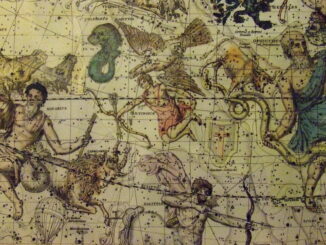
Leo is the 12th largest of the 88 recognized constellations and the third largest of the zodiac constellations, covering approximately 947 square degrees of sky. Its brightest star, Regulus (Alpha Leonis), is the primary star in a multiple-star system about 79 light-years away. With an apparent magnitude of around +1.35, Regulus is among the 25 brightest stars in the night sky.
Leo is visible from latitudes between approximately +90° and -65°. For observers in the Northern Hemisphere, spring is the best season to explore it, particularly during March, April and May. Around 9 p.m. in April, the constellation is well placed for evening observation.
Leo is especially rewarding for galaxy hunters. Its most famous deep-sky attractions are the Leo Triplet and the M96 Group, two collections of galaxies located roughly 30–40 million light-years away. Most require a telescope and reasonably dark skies, although several are accessible with modest amateur equipment.
Leo Triplet (M66 Group)
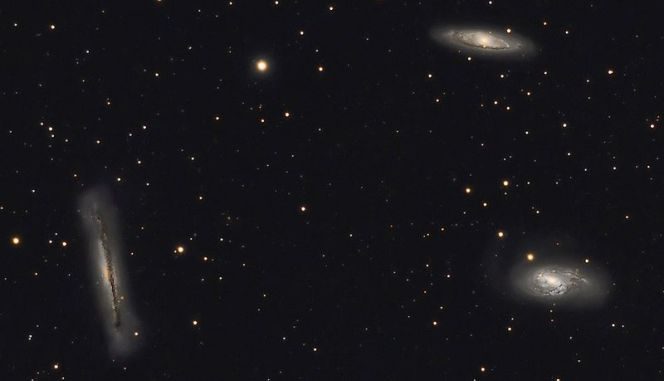
The Leo Triplet is one of the best-known galaxy groupings in the spring sky. It consists of three spiral galaxies: Messier 65, Messier 66 and NGC 3628, all located approximately 35 million light-years away.
The three galaxies are gravitationally associated, and their interactions have influenced their structures. Under dark skies, M65 and M66 can be detected with relatively modest telescopes, while the fainter NGC 3628 is more challenging. A wide-field telescope can show all three in the same field of view.
Messier 65 (M65, NGC 3623)
Messier 65 is an intermediate spiral galaxy approximately 90,000 light-years across. Located around 35 million light-years away, it has an apparent magnitude of about +9.3 and appears as an elongated glow through amateur telescopes.
M65 has a prominent central bulge and relatively tightly wound spiral arms. Its star formation activity is comparatively modest, although observations reveal dust lanes and some younger stellar populations.
Despite its fairly orderly appearance, subtle distortions in its structure may reflect gravitational interactions with neighboring galaxies in the Leo Triplet. A moderate telescope under dark skies can reveal its bright central region and elongated shape.
Messier 66 (M66, NGC 3627)
Messier 66 is a spiral galaxy about 95,000 light-years across, located approximately 35–36 million light-years away. With an apparent magnitude of around +8.9, it is generally the brightest and easiest member of the Leo Triplet to observe.
Its spiral arms are noticeably asymmetric, with prominent dust lanes and regions of active star formation. These distortions are associated with gravitational interactions involving other members of the group, particularly NGC 3628.
Through a small telescope, M66 appears as a bright oval glow with a concentrated center. Larger apertures and dark skies can reveal hints of its irregular spiral structure.
NGC 3628 (Hamburger Galaxy)

NGC 3628 is an edge-on spiral galaxy approximately 100,000 light-years across, located about 35 million light-years away. Nicknamed the Hamburger Galaxy, it is the faintest of the three main Leo Triplet members, with an apparent magnitude of around +9.5.
Its most distinctive feature is a broad, dark dust lane crossing the galaxy’s bright central region. Because we view NGC 3628 almost edge-on, this dust obscures much of its inner structure and gives the galaxy its characteristic appearance.
Gravitational interactions with its neighbors have also produced a remarkable tidal tail extending roughly 300,000 light-years into space. Although this faint structure is best seen in deep astronomical images, it provides striking evidence of the forces acting between the galaxies.
NGC 3628 is more difficult to observe than M65 and M66 because of its lower surface brightness. Under dark skies, a moderate telescope reveals an elongated streak of light, while larger instruments may show the central dust lane.
Leo I Group (M96 Group)
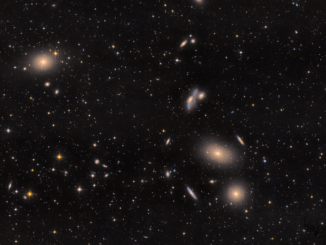
Another important collection of galaxies in Leo is the M96 Group, also known as the Leo I Group. Located approximately 30–40 million light-years away, it includes three Messier galaxies: M95, M96 and M105, along with several fainter companions.
Unlike the tightly grouped Leo Triplet, these galaxies are spread across a wider region of sky. All three Messier objects are accessible to amateur telescopes, although their appearance depends strongly on aperture and sky conditions.
Messier 95 (M95, NGC 3351)
Messier 95 is a barred spiral galaxy located roughly 33 million light-years away. It measures approximately 45,000–50,000 light-years across and has an apparent magnitude of around +9.7.
Its most interesting feature is a ring of active star formation surrounding the central region. The galaxy’s prominent bar helps channel gas toward its inner regions, where new stars form within the ring.
M95 is viewed nearly face-on, making its barred spiral structure particularly attractive in photographs. Through a small telescope, however, it appears mainly as a faint, rounded glow. Larger instruments under dark skies offer a better chance of detecting its central concentration and surrounding disk.
Messier 105 (M105, NGC 3379)
Messier 105 is an elliptical galaxy approximately 32 million light-years away, with an apparent magnitude of around +9.3. Unlike the spiral galaxies elsewhere in this list, M105 has a smooth, rounded appearance without prominent spiral arms or dust lanes.
Its stellar population consists largely of older stars, and relatively little new star formation is taking place. At its center lies a supermassive black hole with a mass estimated at roughly 100–200 million times that of the Sun.
M105 is a useful target for amateur observers because its concentrated central brightness makes it easier to detect than some similarly bright, more diffuse galaxies. Through a small telescope, it appears as a compact oval glow with a brighter core.
Messier 96 (M96, NGC 3368)

Messier 96 is one of the brightest galaxies in the Leo I Group. Located approximately 31–35 million light-years away, it is a spiral galaxy about 100,000 light-years across, with an apparent magnitude of around +9.2.
M96 has an unusually asymmetric appearance, with a bright central region and spiral arms that do not form a perfectly balanced pattern. Its structure is thought to have been influenced by gravitational interactions with neighboring galaxies.
The galaxy also contains regions of ongoing star formation, visible in ultraviolet observations. Like many large galaxies, M96 is believed to contain a supermassive black hole at its center, although its ultraviolet brightness is primarily associated with young, hot stars rather than evidence of black-hole activity.
Through a small telescope, M96 appears as a faint oval patch with a brighter central region. Larger apertures help reveal more of its extended disk.
Other Notable Deep-Sky Objects in Leo
NGC 2903
NGC 2903 is a bright barred spiral galaxy located approximately 30 million light-years away. With an apparent magnitude of around +9.0, it is one of Leo’s most accessible galaxies, despite not being included in the Messier catalogue.
Its central bar and spiral arms contain numerous regions of active star formation. The galaxy is particularly interesting because its brightness and structure make it comparable to several well-known Messier galaxies.
NGC 2903 lies near Leo’s head, not far from the star Lambda Leonis. Under dark skies, a small telescope reveals its elongated glow and bright center, while larger instruments can begin to show its spiral structure.
NGC 3626
NGC 3626 is a spiral galaxy located roughly 70 million light-years away, with an apparent magnitude of around +10.9. It belongs to the NGC 3607 Group, a collection of galaxies in Leo that includes several other moderately bright systems.
Unlike the more prominent galaxies of the Leo Triplet and M96 Group, NGC 3626 is a comparatively modest telescope target. Its compact, bright central region is easier to detect than its faint outer disk.
The galaxy lies in the general region of Zosma (Delta Leonis), which provides a useful starting point for locating it. A moderate telescope and dark skies offer the best chance of seeing its faint oval shape.