Virgo is the second-largest of the 88 recognized constellations and the largest of the zodiac constellations, covering approximately 1,294 square degrees of sky. Its brightest star, Spica (Alpha Virginis), is a multiple-star system with a combined apparent magnitude of about +1.0.
For Northern Hemisphere observers, Virgo is best seen during spring, particularly in April and May. It lies between Leo to the west and Libra to the east, with bright Spica providing a useful starting point for locating the constellation.
Virgo is especially rewarding for deep-sky observers because of its extraordinary concentration of galaxies. The constellation contains 11 Messier objects, many belonging to the nearby Virgo Cluster, as well as 3C 273, one of the brightest quasars visible from Earth.
Virgo Cluster
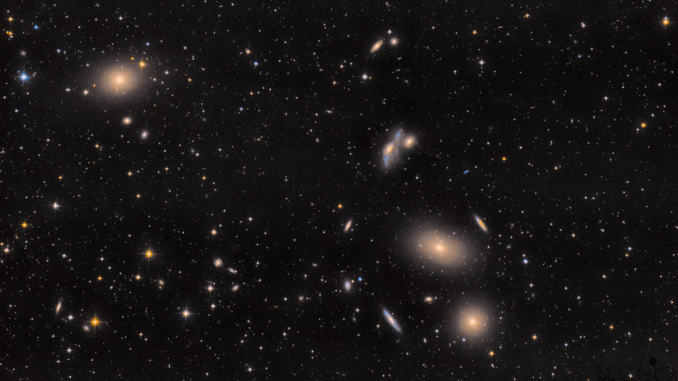
The Virgo Cluster is the nearest large galaxy cluster to the Milky Way, with its central region approximately 54 million light-years away. It contains well over a thousand galaxies, with estimates reaching around 2,000 members.
Among its most prominent members are giant elliptical galaxies such as M87 and M49, along with numerous spiral, lenticular and dwarf galaxies. Their different appearances reveal how galaxies evolve within a crowded environment.
The Virgo Cluster is an important part of our local cosmic neighborhood. It was traditionally considered the central concentration of the Virgo Supercluster, although modern studies describe a more complex arrangement of galaxy groups and large-scale structures.
For amateur observers, Virgo offers one of the richest regions of the sky for galaxy hunting. Under dark skies, moderate telescopes can reveal numerous galaxies within a relatively small area, particularly around the Virgo-Coma Berenices border.
Messier 49 (M49, NGC 4472)
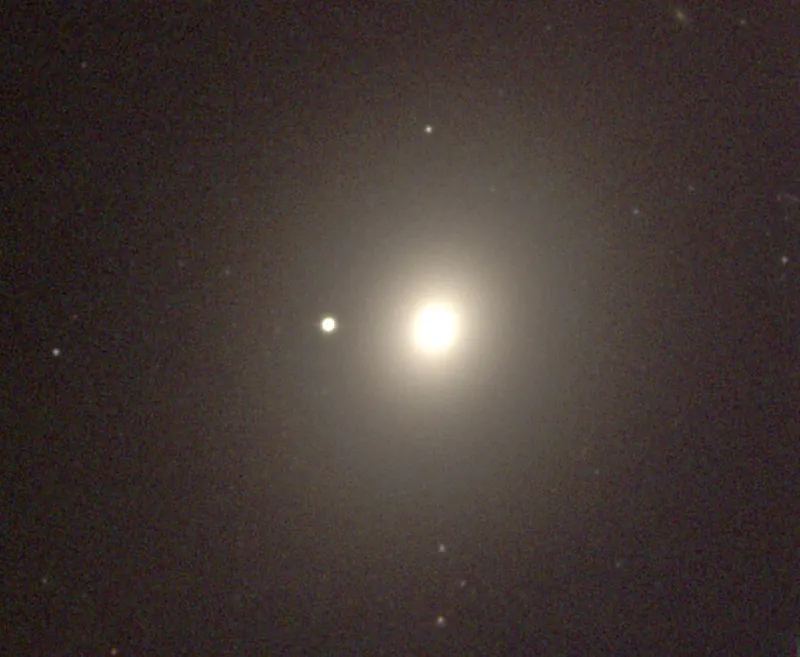
Messier 49 is a giant elliptical galaxy located approximately 60 million light-years away. With an apparent magnitude of around +9.4, it is one of the brightest galaxies in the Virgo Cluster and can be detected through binoculars under favorable dark-sky conditions.
Charles Messier discovered M49 in 1771, making it the first Virgo Cluster galaxy added to his catalog. Unlike spiral galaxies, M49 has a relatively smooth appearance dominated by an enormous population of older stars.
The galaxy contains nearly 6,000 globular clusters, compared with approximately 150 in the Milky Way. At its center lies a supermassive black hole estimated to have a mass of around 565 million Suns.
M49 also shows evidence of interactions with smaller neighboring galaxies. Through a small telescope, it appears as a rounded glow with a bright central concentration.
Messier 58 (M58, NGC 4579)
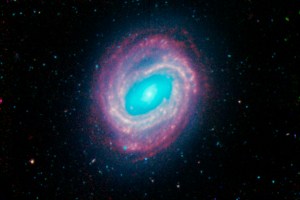
Messier 58 is a barred spiral galaxy located approximately 60 million light-years away and is a member of the Virgo Cluster. With an apparent magnitude of around +10.5, it is accessible to moderate amateur telescopes under dark skies.
M58 contains an active galactic nucleus powered by matter falling toward its central supermassive black hole. Its spiral arms are relatively subdued, with less widespread star formation than in many other spiral galaxies.
Two supernovae were discovered in M58 during the 20th century: SN 1988A and SN 1989M. These events provided astronomers with opportunities to study stellar explosions in a relatively nearby galaxy.
Through a small telescope, M58 generally appears as a faint oval glow with a brighter center. Larger apertures and dark skies make its extended structure easier to detect.
Messier 87 (M87, NGC 4486)
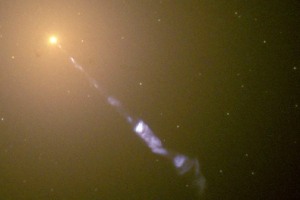
Messier 87 is a giant elliptical galaxy located approximately 54 million light-years away and one of the dominant members of the Virgo Cluster. It contains several trillion stars and an extraordinary population of roughly 15,000 globular clusters.
M87 is particularly famous for the supermassive black hole at its center. In 2019, the Event Horizon Telescope collaboration released the first image of a black hole’s shadow, revealing the dark central region surrounded by glowing material. The black hole has a mass of approximately 6.5 billion Suns.
A spectacular jet of energetic particles extends thousands of light-years from the galaxy’s nucleus. Powered by activity around the central black hole, material in the jet travels at speeds approaching that of light.
Despite its enormous size and distance, M87 is within reach of small amateur telescopes. With an apparent magnitude of around +9.6, it appears as a compact, hazy glow under dark skies, although its famous jet is not visible through ordinary equipment.
Sombrero Galaxy (M104, NGC 4594)
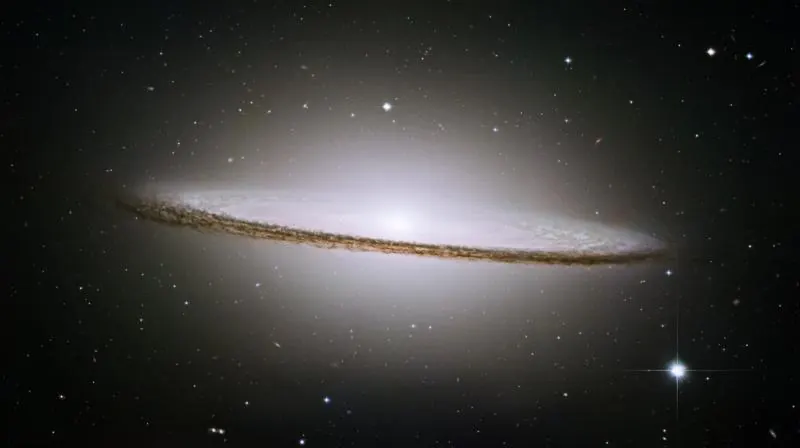
Located approximately 28 million light-years away, the Sombrero Galaxy is one of the most distinctive galaxies in the night sky. Its enormous central bulge and dark ring of dust give it the hat-like appearance from which its popular name is derived.
M104 has traditionally been classified as a spiral galaxy seen nearly edge-on, although more recent observations also support its classification as a lenticular galaxy. Its unusually large central bulge and comparatively smooth structure make it difficult to place neatly into either category.
The Sombrero contains a rich system of approximately 2,000 globular clusters, around ten times the number known in the Milky Way. Its central supermassive black hole has an estimated mass of around one billion Suns.
With an apparent magnitude of about +8.0, M104 is a popular amateur target. It lies in southern Virgo, roughly 11 degrees west of Spica. A small telescope reveals its bright central region, while larger instruments under dark skies may show the distinctive dust lane.
3C 273
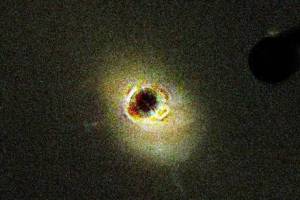
3C 273 is a quasar approximately 2.5 billion light-years away and one of the most distant objects accessible to experienced amateur observers. Despite that enormous distance, it can reach an apparent magnitude of around +13, making it the brightest quasar in the sky at visible wavelengths.
In 1963, astronomer Maarten Schmidt measured its enormous redshift, establishing that 3C 273 was far beyond the Milky Way. This discovery helped transform our understanding of quasars and the extraordinary amounts of energy they produce.
A quasar is the intensely luminous nucleus of an active galaxy, powered by material falling toward a supermassive black hole. In 3C 273, this activity also produces a jet of energetic particles extending approximately 200,000 light-years from the nucleus.
3C 273 is classified as a radio-loud quasar rather than a typical blazar, whose jet points more directly toward Earth. Through a sufficiently large amateur telescope, it appears as a faint, star-like point of light, with no visible indication of its extraordinary nature.
Its luminosity is difficult to comprehend. If 3C 273 were only about 30 light-years away instead of billions, it would appear approximately as bright as the Sun in Earth’s sky.