Pisces is the 14th largest of the 88 recognized constellations and the fourth largest of the zodiac constellations, covering approximately 889 square degrees of sky. Its brightest star, Eta Piscium, is a yellow giant about 294 light-years away, with an apparent magnitude of +3.62.
Pisces is visible from latitudes between approximately +90° and -65°, with November offering the best evening views for Northern Hemisphere observers. It lies in a region of the sky traditionally known as the Sea, alongside other water-themed constellations such as Capricornus (the Sea Goat), Aquarius (the Water Bearer), Cetus (the Whale), Delphinus (the Dolphin), and Eridanus (the River).
Although Pisces is a relatively faint constellation, it contains several fascinating deep-sky objects. Its best-known target is the spiral galaxy M74, but the constellation also contains interacting galaxies and distant galaxy clusters that reveal the effects of gravity on an enormous scale.
Notable Deep-Sky Objects in Pisces
Messier 74 (M74, NGC 628)
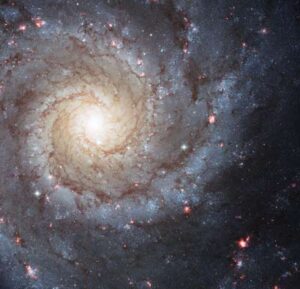
Messier 74 is a classic example of a grand-design spiral galaxy, with two prominent spiral arms winding outward from its central region. Located approximately 32 million light-years away, it contains billions of stars and has an apparent visual magnitude of around +10.0.
Despite its brightness on paper, M74 is one of the most difficult Messier objects to observe. Because we see the galaxy almost face-on, its light is spread across a large area, producing very low surface brightness.
Under dark, transparent skies, a moderate telescope may reveal its faint, rounded glow and slightly brighter center. Larger apertures offer a better chance of detecting its spiral structure. M74 lies approximately 1.5 degrees east-northeast of Eta Piscium, making that star a useful starting point.
Several supernovae have been observed in M74, including SN 2002ap and SN 2003gd. Astronomers have also identified an unusually luminous X-ray source, CXOU J013651.1+154547, which has been investigated as a possible intermediate-mass black hole. Its precise nature and mass remain uncertain.
CGCG 436-030 (PGC 4798)
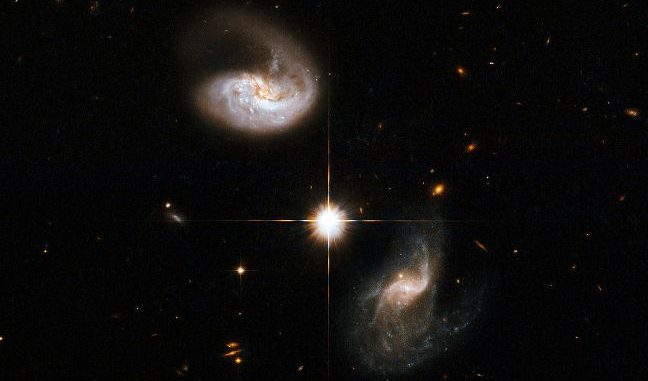
CGCG 436-030 is a pair of interacting galaxies located approximately 400 million light-years away. Their distorted shapes provide a striking example of how gravitational encounters can transform galaxies over time.
The larger galaxy displays a long, curling tidal tail, while the smaller companion has additional streams of material extending away from its main body. These features develop as the galaxies pull on each other’s stars and gas during their encounter.
A bright point of light appearing between the galaxies in the featured image is actually a foreground star in our own Milky Way, rather than part of the interacting pair.
At such a great distance, CGCG 436-030 is primarily an astrophotography target rather than a practical visual object for ordinary amateur telescopes.
CL 0024+1654
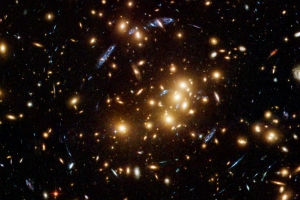
CL 0024+1654 is a distant galaxy cluster located roughly 5 billion light-years away. Its enormous combined mass, including both visible matter and dark matter, bends light traveling from galaxies much farther behind it.
This phenomenon, known as gravitational lensing, produces the striking blue arcs visible around the cluster in Hubble images. Some of these arcs are multiple distorted images of the same distant background galaxy, whose light has followed different paths around the intervening cluster.
By studying the shapes and positions of these arcs, astronomers can estimate how mass is distributed throughout the cluster, including the otherwise invisible dark matter. CL 0024+1654 is therefore particularly valuable for understanding the gravitational structure of galaxy clusters.
Although far beyond the reach of ordinary visual observing, the cluster is a remarkable example of how gravity can act as a natural cosmic lens.
NGC 520 (Arp 157)
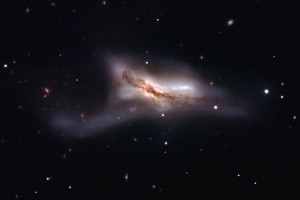
NGC 520 is a pair of merging disk galaxies located approximately 100 million light-years away. Their collision began around 300 million years ago, and the two galactic nuclei remain separate as the merger continues.
The interaction has produced an unusual structure of overlapping stellar disks and dark dust lanes. In detailed images, the system resembles a cross, with streams of stars and gas extending away from its central regions.
NGC 520 is included as Arp 157 in the Atlas of Peculiar Galaxies. Its appearance makes it a particularly interesting example of the dramatic changes that occur when galaxies merge.
With an apparent magnitude of around +11, NGC 520 can be detected with moderate amateur telescopes under dark skies. It generally appears as a faint, elongated glow, although larger apertures may reveal some of its irregular structure.
NGC 60
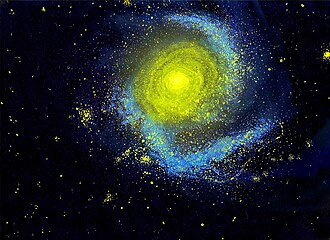
NGC 60 is a distant spiral galaxy located approximately 500 million light-years away. With an apparent magnitude of around +14.85, it is a challenging target requiring a large amateur telescope or long-exposure astrophotography.
The galaxy is notable for its unusually asymmetric spiral structure, with one arm appearing considerably more extended and distorted than the other. Such irregularities can result from gravitational encounters, although internal processes within a galaxy can also influence the shape of its spiral arms.
The precise cause of NGC 60’s unusual appearance remains uncertain. A possible interacting companion has been identified, but its role in shaping the galaxy has not been conclusively established.