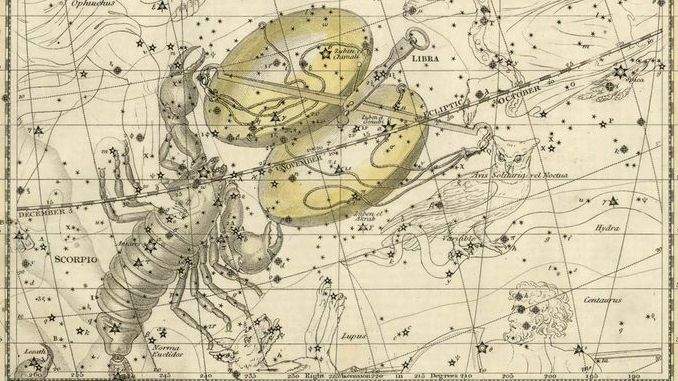
Libra is a relatively faint zodiac constellation, traditionally depicted as a set of scales held by neighboring Virgo. Its Latin name means “balance” or “scales,” and it is the only zodiac constellation represented by an inanimate object. Visible from roughly +65° to −90° latitude, Libra is best seen in May and June, during late spring and early summer in the Northern Hemisphere and autumn to early winter in the Southern Hemisphere.
Finding Libra in the Night Sky
Libra has no particularly bright stars of its own, so the easiest way to find it is by using the much brighter Spica and Antares on either side as landmarks. Follow the curve of the Big Dipper’s handle to Arcturus, then continue to Spica in Virgo. From there, look east toward reddish Antares in Scorpius. Libra lies between these two stars.
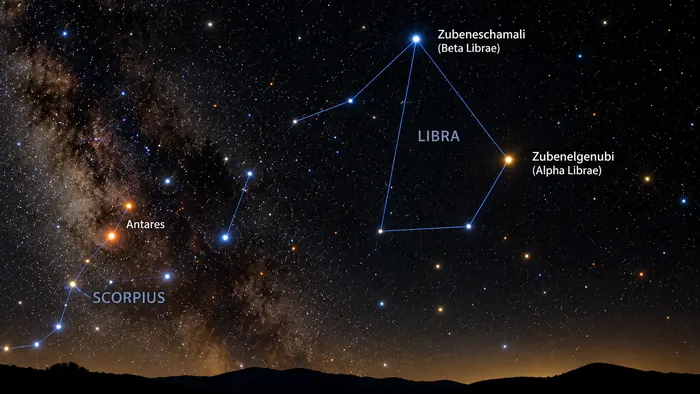
Within this relatively faint region, Libra’s principal stars form a loose four-sided pattern, traditionally depicted as a weighing balance, although the shape is not immediately obvious to the naked eye.
Libra’s Principal Stars
Four stars form the main outline of Libra’s Scales, although none is particularly bright. Three retain names from the constellation’s ancient association with neighboring Scorpius:
- Zubeneschamali (Beta Librae) — Libra’s brightest star, a hot blue-white star of magnitude 2.6, located about 185 light-years away. Despite its Beta designation, it outshines Alpha Librae and is sometimes described as appearing pale green, although this is a perceived color rather than its actual blue-white color. Its name means “Northern Claw.”
- Zubenelgenubi (Alpha Librae) — Libra’s second-brightest star, at magnitude 2.8, roughly 75 light-years away. Although it appears as a single point of light to the naked eye, binoculars can reveal two widely separated stars. Its name means “Southern Claw.”
- Zubenelhakrabi (Gamma Librae) — An orange giant of magnitude 3.9, approximately 160 light-years away. Its name means “Scorpion’s Claw.”
- Brachium (Sigma Librae) — A red giant of magnitude 3.3, about 290 light-years away. Its name comes from the Latin word for “arm,” reflecting an older interpretation of the constellation’s stars.
Why Libra’s Stars Have Scorpion Names
In ancient Greek astronomy, the stars of Libra were often regarded as the outstretched claws of neighboring Scorpius rather than a separate constellation, giving the Scorpion a much larger outline than it has today. However, the Scales were not simply a later Roman invention. Babylonian astronomers had already recognized a Balance in this region of the sky, while Greek astronomy preserved both the Claws and Scales traditions. Libra eventually became firmly established as the Scales in Roman astronomy, although its principal star names still reflect the older Scorpion imagery.
NGC 5897: Ancient Stars That Shine Blue
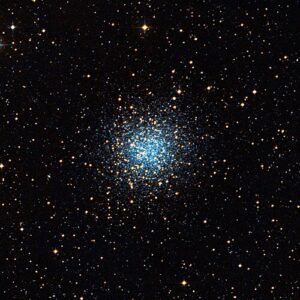
Libra contains no Messier objects, but NGC 5897 is one of its most interesting deep-sky targets. Located about 40,000 light-years away, this globular cluster is more than 12 billion years old, making it a relic of the early Milky Way. Among its ancient stars are numerous blue horizontal-branch stars, which may seem surprising because blue stars are often young and massive.
However, these are older, evolved stars that have already passed through the red-giant stage. They now burn helium in their cores, and their high surface temperatures give them their blue color.
NGC 5897 is unusually loose and diffuse for a globular cluster. In a small telescope, it appears as a broad, faint glow, while larger instruments under dark skies may resolve some individual stars.
The Star That Seemed Older Than the Universe
One of Libra’s most remarkable stars is HD 140283, nicknamed the Methuselah Star after the famously long-lived biblical figure. Located about 190 light-years away, it contains remarkably few elements heavier than hydrogen and helium, suggesting it formed very early in the universe’s history. At approximately magnitude 7.2, it is too faint for the naked eye but can be seen through binoculars under suitable conditions.
The star became famous when early calculations suggested an age of 16 billion years—older than the universe itself. Improved measurements in 2013 reduced the estimate to around 14.5 billion years, still slightly above the universe’s accepted age of 13.8 billion years, but within the margin of uncertainty. Later studies produced younger estimates, including approximately 12 billion years in 2021.
HD 140283 was never actually older than the universe. The apparent contradiction arose from uncertainties in measuring stellar ages, which improved observations and models have helped resolve. It remains one of the Milky Way’s most ancient known stars, formed when the universe was still relatively young.
Virgo, Libra and the Scales of Justice
In one classical tradition, neighboring Virgo was identified with Astraea, the goddess of justice, who lived among humanity during a mythical Golden Age. As human behavior deteriorated, she eventually abandoned Earth and ascended to the heavens. The Scales became a fitting symbol of the justice she represented, traditionally associated with weighing right and wrong. This connection helped establish the familiar image of the Maiden and the Scales together, although Libra’s identity as the Balance had much older origins.
The constellation’s name also has an unexpected everyday legacy. The Latin libra meant “balance” or “scales” and was associated with a Roman unit of weight. That connection survives in the abbreviation “lb” for pound.