
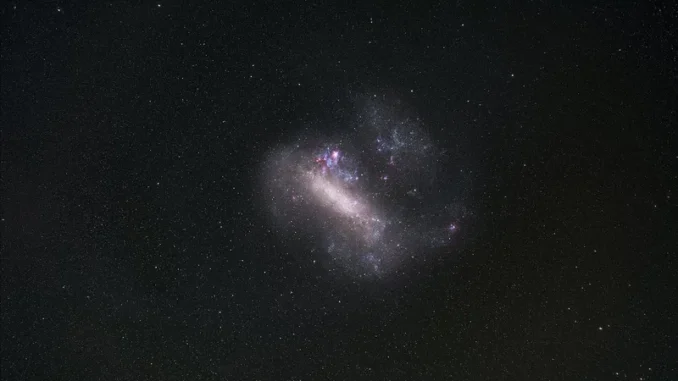
The Large Magellanic Cloud (LMC) is a dwarf galaxy located approximately 163,000 light-years from Earth. It is one of the Milky Way’s nearest galactic neighbors and is generally classified as a Magellanic-type barred spiral galaxy, although its appearance is highly irregular.
The LMC is commonly described as a satellite galaxy of the Milky Way. However, astronomers continue to investigate its orbital history. Its high velocity suggests that it may be making its first close passage around our galaxy rather than following the long-established orbit once assumed.
The LMC also interacts gravitationally with the Small Magellanic Cloud (SMC). Together, these two galaxies have shaped one another through tidal forces and the exchange of gas.
Quick Facts
- Constellations: Dorado and Mensa
- Coordinates: RA 05h 23m 34s, Dec −69° 45′
- Distance: Approximately 163,000 light-years
- Object type: Magellanic-type barred spiral galaxy (SB(s)m)
- Apparent dimensions: Approximately 10.8° × 9.2°
- Diameter: Approximately 14,000 light-years
- Apparent magnitude: About +0.9
- Other designations: LMC, ESO 56-G 115, PGC 17223, Nubecula Major
Visibility
The Large Magellanic Cloud is one of the most impressive naked-eye objects in the Southern Hemisphere. Located mainly within Dorado and Mensa, it appears as a large, faint, cloud-like patch spanning roughly 10 degrees of sky, equivalent to about 20 full Moon diameters.
Because of its far-southern declination, the LMC is not visible from most of North America or Europe. It can be seen from locations south of approximately 20° north latitude, although observers farther south enjoy much better views.
From dark southern skies, its irregular shape is readily apparent without optical aid. Binoculars reveal rich star fields and brighter concentrations of light, while telescopes show individual clusters and nebulae within the galaxy.
Physical Properties
The LMC has an irregular appearance but retains a prominent central bar. Unlike the symmetrical bars seen in many spiral galaxies, its bar is offset from the galaxy’s outer structure.
This unusual shape is thought to reflect a complex history of gravitational interactions, particularly with the Small Magellanic Cloud and possibly the Milky Way. These encounters have disturbed the distribution of stars and gas within the galaxy.
The LMC and SMC are also associated with extensive structures of neutral hydrogen, including the Magellanic Bridge connecting the two galaxies and the Magellanic Stream extending across a large part of the sky.
These features provide important evidence of gravitational interactions and the movement of gas between the Magellanic Clouds and their surroundings. Astronomers continue to investigate how much of their present structure was produced by encounters with each other and how much by the Milky Way.
The LMC is also a valuable target for X-ray astronomy. Its X-ray sources include stellar remnants, supernova remnants and binary systems in which compact objects such as neutron stars or black holes accrete material from companion stars.
Star Formation
Despite its relatively small size, the LMC contains enormous quantities of gas and dust and remains an active site of star formation. Its most spectacular stellar nursery is the Tarantula Nebula, one of the largest and most active star-forming regions in the Local Group.
The Tarantula Nebula contains massive young stars whose intense radiation and powerful stellar winds shape the surrounding clouds. It also provides astronomers with an opportunity to study star formation on a scale rarely seen so close to the Milky Way.
Elsewhere, the LMC contains hundreds of open star clusters, numerous globular clusters, planetary nebulae and enormous populations of giant and supergiant stars.
One of its most famous events was Supernova 1987A, observed in February 1987. It was the nearest supernova observed since the invention of the telescope and became one of the most extensively studied stellar explosions in modern astronomy.
Notable Features
Among the LMC’s more unusual objects is the Lionel Murphy Nebula (N86), a nitrogen-rich supernova remnant named after an Australian politician and High Court judge.
The nickname originated with astronomers who noticed that the remnant’s outline resembled Murphy’s distinctive nose. Although informal, the name has become an entertaining footnote in the history of astronomical observations.
Beyond such curiosities, the LMC remains one of astronomy’s most important nearby laboratories. Its relatively well-established distance allows researchers to compare different types of stars, measure their luminosities and investigate how galaxies evolve through star formation and gravitational encounters.