Gemini is the 30th largest of the 88 recognized constellations and the 8th largest of the zodiac constellations, covering about 514 square degrees of the northern sky. Its brightest star is Pollux (Beta Geminorum), an orange giant about 34 light-years away with an apparent magnitude of +1.14.
Gemini is visible from latitudes between approximately +90° and -60°. For Northern Hemisphere observers, January and February offer particularly good evening views. The constellation is easy to recognize by its two prominent stars, Pollux and Castor, representing the heads of the mythological twins.
Gemini contains one Messier object, the bright open cluster M35, along with several fainter star clusters, planetary nebulae and the remarkable Jellyfish Nebula supernova remnant. Some are accessible with binoculars, while others are challenging telescope targets.
Star Clusters in Gemini
Messier 35 (NGC 2168)
Messier 35 is Gemini’s best-known deep-sky object and one of the finest open clusters for amateur observers. Located about 2,800 light-years away, it contains several hundred stars and is relatively young, with an estimated age of around 100 million years.
The cluster spans roughly 24 light-years and shines at an apparent magnitude of about +5.3, making it just visible to the naked eye under sufficiently dark skies. Binoculars reveal a misty patch, while a small telescope resolves numerous stars spread across an area of sky comparable to the full Moon.
M35 is best viewed at low magnification, which allows its broad, scattered pattern to be appreciated in a single field. It is also one of the most accessible examples in our guide to beautiful open star clusters.
NGC 2158 and IC 2157
Close to M35 are two much fainter open clusters. NGC 2158 lies just southwest of M35 in the same apparent field, but is actually far more distant, at roughly 16,000 light-years from Earth.
NGC 2158 is also considerably older, with an estimated age of around 2 billion years. Its stars form a compact, concentrated group that contrasts with the brighter, more widely scattered stars of M35. A telescope under dark skies is needed to appreciate it, and larger apertures help resolve its individual stars.
IC 2157 is another faint open cluster in the same general region. Although all three clusters appear relatively close together in the sky, they are separate stellar systems at different distances from Earth. IC 2157 is a more challenging target than M35 and is best attempted with a telescope.
NGC 2129
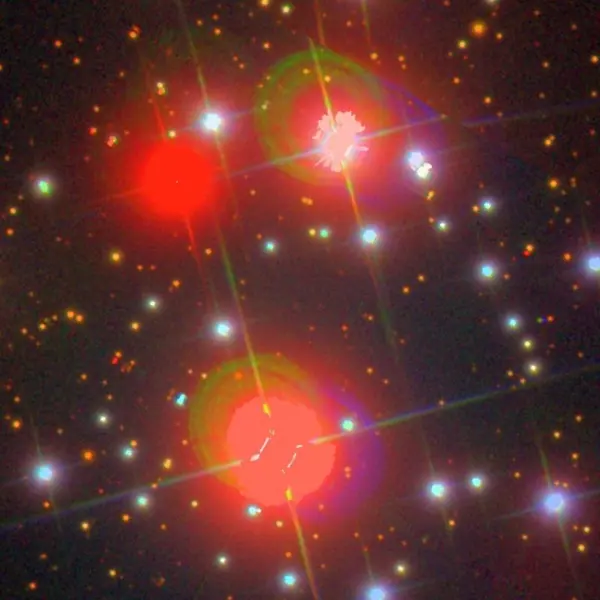
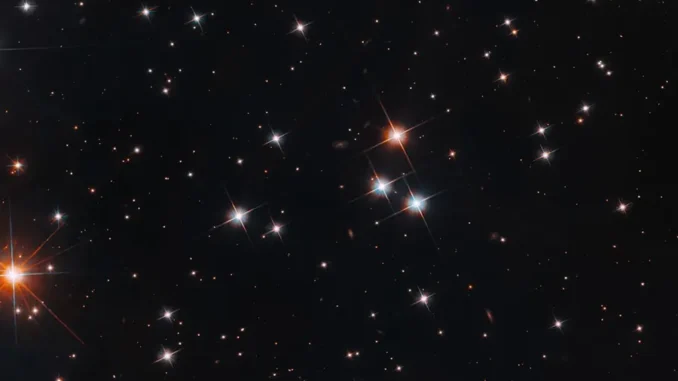
NGC 2129 is a young open cluster located several thousand light-years away in Gemini. Its stars are predominantly young and hot, making it a useful contrast to much older clusters such as NGC 2158 and NGC 2355.
Two prominent B-type stars dominate its central region. Astronomical studies of the cluster’s stellar motions have helped establish that its members form a genuine physical group rather than a chance alignment of unrelated stars.
NGC 2129 can be observed with a small telescope, although it is less conspicuous than M35. Its brightest stars are relatively easy to pick out, while the surrounding fainter members benefit from darker skies and additional aperture.
NGC 2355
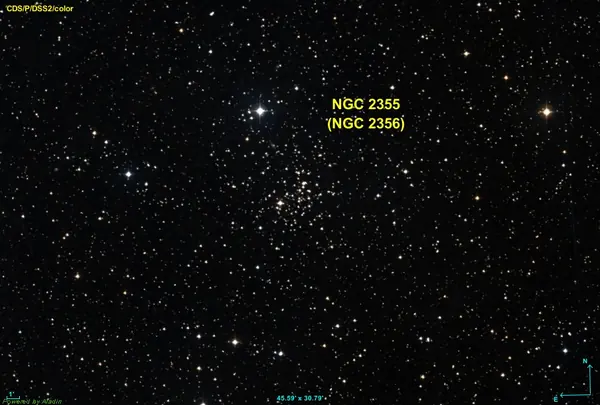
NGC 2355 is an old open cluster, with an estimated age of around 1 billion years. Located roughly 5,000–6,000 light-years away, it provides a striking contrast with the much younger NGC 2129.
Most open clusters gradually disperse as gravitational encounters and the Milky Way’s tidal forces pull their stars apart. NGC 2355 has survived for around a billion years, making it an interesting example of a relatively long-lived stellar group.
At around 10th magnitude, NGC 2355 is far fainter than M35. It appears as a modest concentration of stars through a telescope, with larger instruments helping to reveal more of its members.
Nebulae in Gemini
Lion Nebula (NGC 2392)
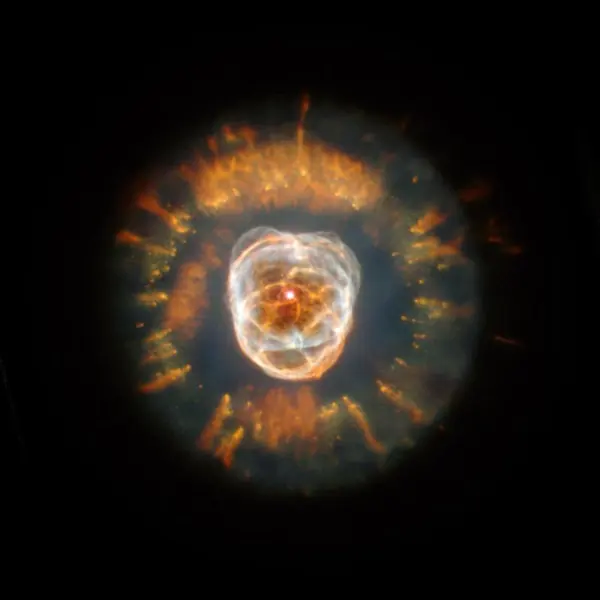
NGC 2392 is one of Gemini’s most distinctive planetary nebulae, located roughly 5,000 light-years away. Historically known as the Eskimo Nebula because its surrounding shells were thought to resemble a fur-lined hood, it is now also called the Lion Nebula.
Despite the name, a planetary nebula has nothing to do with planets. It forms when an aging star sheds its outer layers, leaving behind a hot stellar remnant whose ultraviolet radiation causes the expelled gas to glow.
NGC 2392 contains a complex arrangement of shells, knots and filaments created during episodes of stellar mass loss. Its relatively high surface brightness makes it accessible to modest amateur telescopes, although higher magnification and larger apertures are needed to appreciate its internal structure.
Jellyfish Nebula (IC 443)
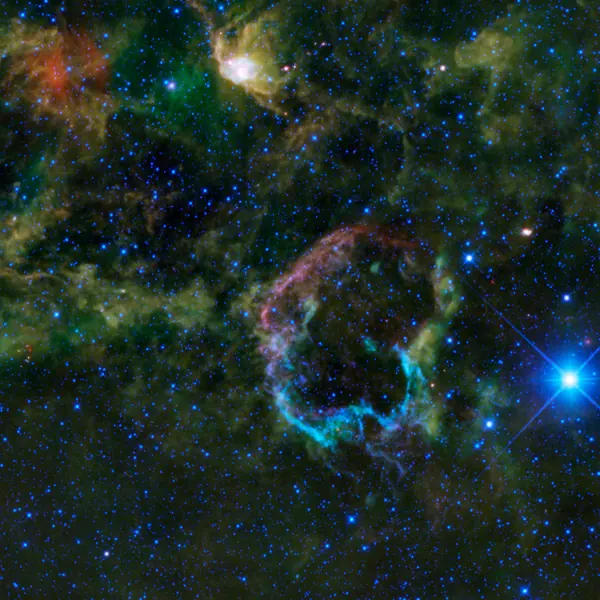
The Jellyfish Nebula is an enormous supernova remnant near the Gemini-Taurus border. Located roughly 5,000 light-years away, it formed when a massive star exploded, leaving behind an expanding cloud of gas and debris spanning approximately 70 light-years.
Its intricate arcs and filaments result from the supernova shock wave colliding with surrounding clouds of gas. These interactions produce structures visible across several wavelengths, including optical, infrared, radio and X-ray light.
IC 443 also contains an associated neutron star, the compact remnant left by the explosion. Its combination of a stellar remnant, expanding shock waves and dense molecular clouds makes it particularly valuable to astronomers studying supernova evolution.
Despite its impressive appearance in photographs, the Jellyfish Nebula is a difficult visual target. Its light is spread across a large area, and observing its faint filaments generally requires very dark skies, a suitable nebula filter and considerable patience.
Medusa Nebula (Abell 21)
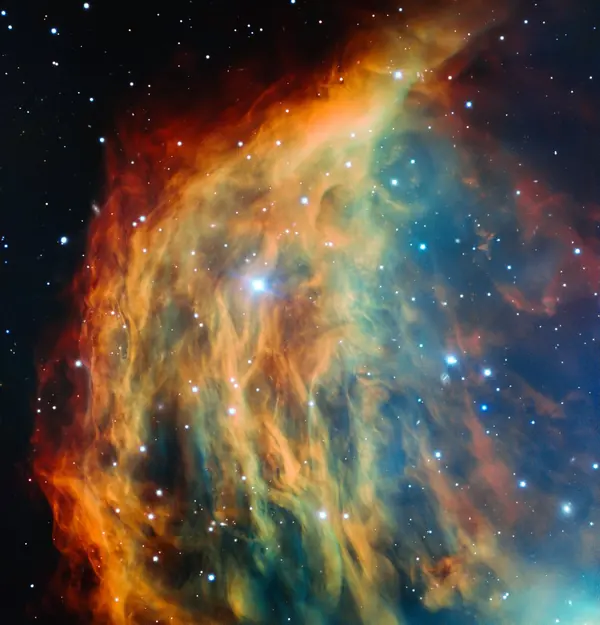
The Medusa Nebula was discovered in 1955 by astronomer George O. Abell. Its tangled filaments initially suggested a supernova remnant, but subsequent research established that it is an old planetary nebula.
It formed when an aging star expelled its outer layers into space, leaving behind a hot stellar core evolving toward the white dwarf stage. Over time, the expanding gas developed the broad, intricate structure visible in astronomical photographs.
Located roughly 1,500 light-years away, the Medusa Nebula covers a surprisingly large area of sky. However, its light is spread thinly across that area, resulting in very low surface brightness.
This makes Abell 21 considerably harder to observe than its apparent size might suggest. Dark, transparent skies and an appropriate nebula filter are especially helpful, while astrophotography reveals far more of its delicate structure than most visual observations.
NGC 2371-2
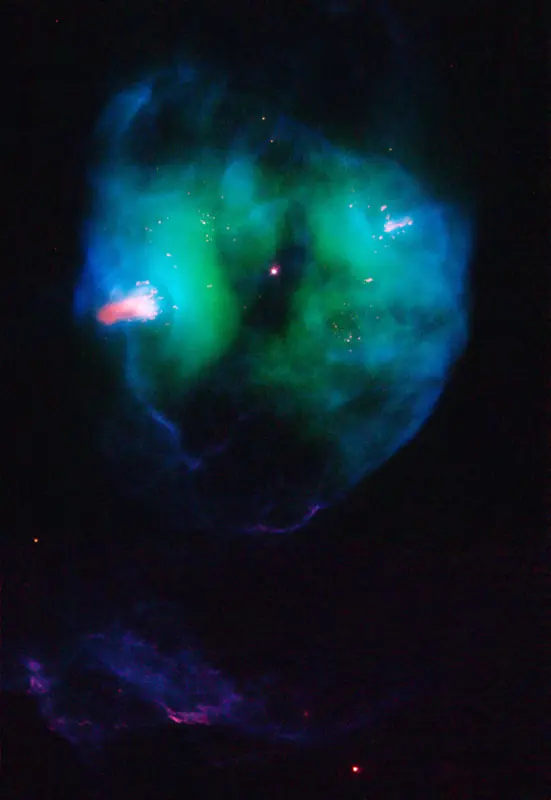
NGC 2371-2 is a planetary nebula located approximately 4,000 light-years away in Gemini. Its unusual double-lobed appearance led early observers to catalogue its two brightest regions separately as NGC 2371 and NGC 2372, although both belong to the same object.
At its center is the extremely hot remnant of the star that produced the nebula. Ultraviolet radiation from this exposed core illuminates the surrounding gas, while successive episodes of mass loss have helped shape its unusual structure.
With a visual magnitude of approximately 11.2, NGC 2371-2 is considerably fainter than NGC 2392. It can nevertheless be detected with a moderate amateur telescope under suitable conditions. Higher magnification may help reveal its elongated or double-lobed appearance, particularly under dark skies.
The nebula lies a short distance southwest of Castor, making that bright star a useful starting point when locating it.