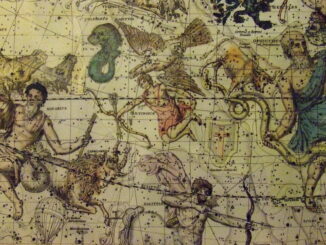
Aries is the 39th largest of the 88 recognized constellations and the second smallest of the zodiac constellations, covering approximately 441 square degrees of sky. Its brightest star, Hamal (Alpha Arietis), is an orange giant about 66 light-years away, with an apparent magnitude of around +2.0.
Aries lies between Pisces to the west and Taurus to the east. For Northern Hemisphere observers, November and December offer particularly good evening views. Although the constellation has no Messier objects, it contains several interesting galaxies, including interacting systems and unusual examples of star formation.
NGC 772 (Arp 78)
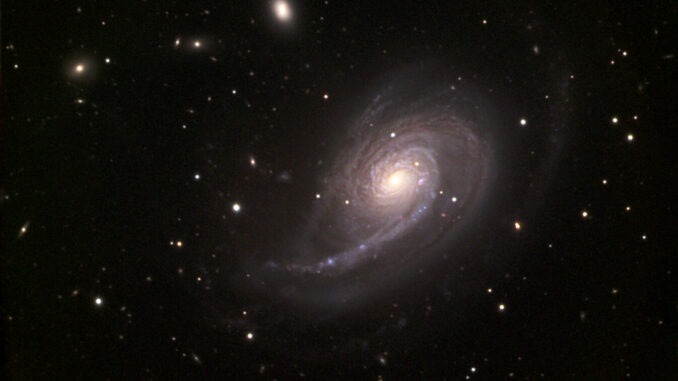
NGC 772 is a large, unbarred spiral galaxy located approximately 130 million light-years away. It is considerably larger than the Milky Way and is best known for its unusually long, asymmetric spiral arm.
This prominent arm contains bright regions of star formation and young blue star clusters. Its distorted appearance is thought to result from gravitational interactions with smaller companion galaxies, particularly NGC 770, a nearby dwarf elliptical galaxy.
NGC 772 has also hosted several observed supernovae, including SN 2003hl and SN 2003iq, both discovered in 2003. These stellar explosions provide astronomers with opportunities to study the final stages of massive stars.
With an apparent magnitude of around +10.3, NGC 772 can be detected through a moderate amateur telescope under dark skies. It appears as a faint oval glow with a brighter central region, while its distinctive spiral arm is much more difficult to see visually.
Look for NGC 772 southeast of Sheratan (Beta Arietis), at approximately RA 01h 59m 20s and Dec +19° 00′. Its much fainter companion NGC 770 is a considerably more challenging target.
NGC 1156
NGC 1156 is a dwarf irregular galaxy located approximately 25 million light-years away. Unlike spiral galaxies, it has no clearly defined spiral arms, although it contains a relatively prominent central region and numerous areas of active star formation.
One of its most unusual features is the presence of gas rotating in different directions within the galaxy. This counter-rotation may preserve evidence of a past gravitational encounter, although the precise explanation remains uncertain.
NGC 1156 also contains bright stellar nurseries where young, massive stars illuminate surrounding clouds of hydrogen gas. These regions give the galaxy a scattered, irregular appearance in detailed images.
With an apparent magnitude of around +12.3, NGC 1156 is a challenging target for smaller telescopes. Under dark skies, a moderate or large amateur instrument may reveal its faint, diffuse glow.
Look for the galaxy northwest of Botein (Delta Arietis), at approximately RA 02h 59m 42s and Dec +25° 14′.
NGC 972
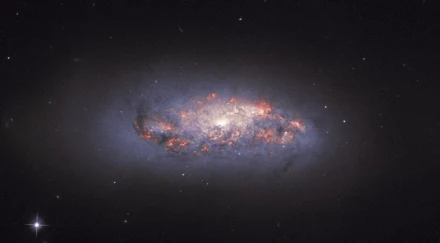
NGC 972 is a spiral galaxy located approximately 70 million light-years away. It is particularly notable for its extensive dark dust lanes and bright regions of active star formation.
In Hubble images, pinkish clouds of glowing hydrogen gas are scattered across the galaxy’s central regions. These stellar nurseries are illuminated by hot, young stars, while the surrounding dust partly obscures the galaxy’s spiral structure.
NGC 972 provides an interesting example of how gas and dust influence the appearance and evolution of a spiral galaxy. Its star-forming regions reveal where new generations of stars are developing.
With an apparent magnitude of around +12, NGC 972 is best attempted with a moderate or large amateur telescope under dark skies. It appears as a faint, elongated glow, with its intricate dust lanes and star-forming regions primarily visible in photographs.
The galaxy lies at approximately RA 02h 34m 13s and Dec +29° 19′.
NGC 678
NGC 678 is an edge-on spiral galaxy located approximately 130 million light-years away. Its most distinctive feature is a dark dust lane running across its elongated disk.
Because we view the galaxy nearly edge-on, much of its spiral structure is hidden. However, this orientation makes its thin stellar disk and central dust lane particularly interesting in detailed images.
With an apparent visual magnitude of around +12.2, NGC 678 is a challenging but achievable target for moderate amateur telescopes under dark skies. It appears as a narrow, elongated patch of light, while the dust lane requires more demanding observing conditions.
NGC 680
NGC 680 is an elliptical galaxy located in the same general region of sky as NGC 678, at a distance of approximately 130 million light-years. Unlike its spiral neighbor, it has a comparatively smooth, rounded appearance without prominent spiral arms.
NGC 680 belongs to a small group of galaxies that also includes NGC 678 and NGC 691. These systems provide an opportunity to compare different galaxy types within the same region of sky.
With an apparent magnitude of around +11.9, NGC 680 appears as a small, diffuse glow through a telescope, with a brighter central concentration. It is easier to detect than many of the fainter galaxies in the group.
NGC 691
NGC 691 is a spiral galaxy located approximately 120–125 million light-years away. It is distinguished by its multiple spiral arms and relatively bright central region.
The galaxy belongs to the NGC 691 Group, which also includes NGC 678 and NGC 680. Its broad spiral structure is attractive in astronomical photographs, although its relatively low surface brightness makes the outer arms difficult to observe visually.
With an apparent magnitude of around +11.4, NGC 691 can be detected with a moderate amateur telescope under dark skies. It generally appears as a faint oval glow with a more concentrated center.
Other Deep-Sky Objects in Aries
Aries contains several additional galaxies worth exploring. These include the interacting spiral pairs NGC 877 and NGC 876, and NGC 935 and IC 1801, whose gravitational encounters have affected their structures.
Other notable objects include the elliptical galaxy NGC 821 and Segue 2, an extremely faint dwarf satellite galaxy of the Milky Way.
Although Aries lacks the bright star clusters and nebulae found in some larger constellations, its collection of galaxies makes it an interesting destination for observers with telescopes and access to dark skies.