
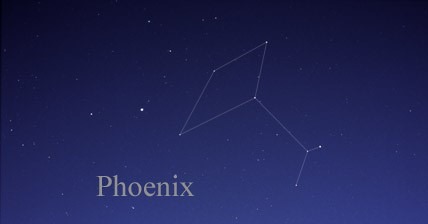

Phoenix (the Phoenix) is a southern constellation introduced by Petrus Plancius in the late 16th century. It represents the legendary firebird associated with rebirth and renewal, a creature whose story has appeared in different forms across several ancient cultures.
Although Phoenix contains relatively few bright stars, it is home to some fascinating deep-sky objects, including Robert’s Quartet, a group of interacting galaxies, and the distant Phoenix Cluster, where astronomers have discovered extraordinary activity surrounding a supermassive black hole.
Where Is Phoenix and When Can You See It?
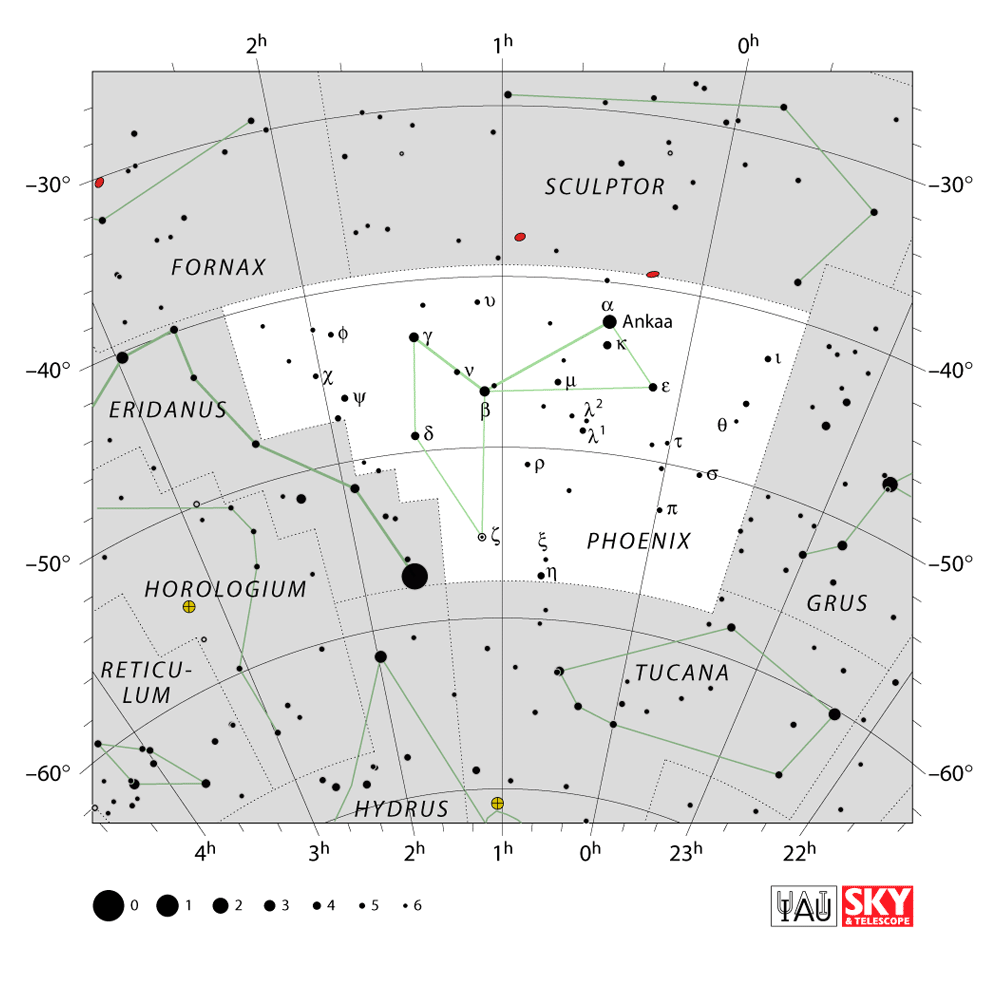
Phoenix is the 37th-largest constellation, covering approximately 469 square degrees of the southern sky. It borders Eridanus, Grus, Fornax, Hydrus, Sculptor, and Tucana.
The best time to observe Phoenix is September through November, particularly October, when it is well placed in the evening sky. Phoenix is most easily seen from the Southern Hemisphere, although its northernmost stars can be observed from some lower northern latitudes. The constellation is not visible from Britain.
To locate Phoenix, begin with Fomalhaut, the bright star in Piscis Austrinus, and look eastward toward Ankaa (Alpha Phoenicis). Ankaa is the constellation’s brightest star and provides a useful starting point for identifying its fainter companions.
History and Mythology of Phoenix
Phoenix was introduced by Flemish cartographer Petrus Plancius using observations gathered by Dutch navigators Pieter Dirkszoon Keyser and Frederick de Houtman during voyages to the East Indies. It appeared in Johann Bayer’s 1603 star atlas, Uranometria, and is now one of the 88 constellations recognized by the International Astronomical Union.
The constellation takes its name from the phoenix, a legendary bird associated with fire, immortality, and rebirth. In the best-known versions of the myth, the phoenix lives for hundreds of years before reaching the end of its life. It then dies in a fiery nest, only for a new phoenix to emerge and begin the cycle again. The bird became a powerful symbol of renewal in Greek and Roman traditions, with related imagery also appearing in other ancient cultures.
However, the constellation itself is a relatively modern creation rather than one of the constellations recognized by ancient Greek astronomers.
Phoenix is also one of the informal Southern Birds, alongside Grus, Pavo, and Tucana.
Notable Stars in Phoenix
- Ankaa (Alpha Phoenicis) – The brightest star in Phoenix, an orange giant approximately 77 light-years away, shining at magnitude 2.4. It is part of a binary system whose stars orbit one another approximately every 10.5 years. Ankaa’s name comes from an Arabic term associated with a legendary bird.
- Beta Phoenicis – A binary system approximately 200 light-years away, with a combined magnitude of about 3.3. It consists of two evolved yellow giant stars orbiting one another over a period of roughly 170 years.
- Gamma Phoenicis – A red giant approximately 230 light-years away, shining at magnitude 3.4. It is a variable star whose brightness changes slightly as its outer atmosphere pulsates.
- Delta Phoenicis – A yellow giant approximately 140 light-years away, with an apparent magnitude of about 3.9.
- Zeta Phoenicis – An eclipsing binary system approximately 300 light-years away. Its brightness varies as the two stars periodically pass in front of one another from Earth’s perspective.
- Nu Phoenicis – A yellow-white main-sequence star approximately 50 light-years away, with a magnitude of about 4.9. It is a relatively nearby example of a star somewhat hotter and more massive than the Sun.

Notable Deep-Sky Objects in Phoenix
Phoenix contains no Messier objects, but several of its galaxies are particularly interesting to astronomers studying galaxy interactions, star formation, and black holes.
Phoenix Cluster — An Extraordinary Galaxy Cluster
The Phoenix Cluster (SPT-CL J2344-4243) is a massive galaxy cluster approximately 5.7 billion light-years away. It contains hundreds of galaxies embedded within an enormous cloud of extremely hot gas that emits powerful X-rays.
At its center lies a giant galaxy containing a supermassive black hole. Astronomers have observed unusually vigorous star formation in this central galaxy, with estimates reaching several hundred solar masses of new stars per year. This is remarkable because the central galaxies of most massive clusters form relatively few new stars.
The Phoenix Cluster provides an important example of the relationship between cooling gas, star formation, and the energy released by supermassive black holes.
Its enormous distance and faintness place it far beyond the reach of ordinary amateur telescopes.
Robert’s Quartet — Four Interacting Galaxies
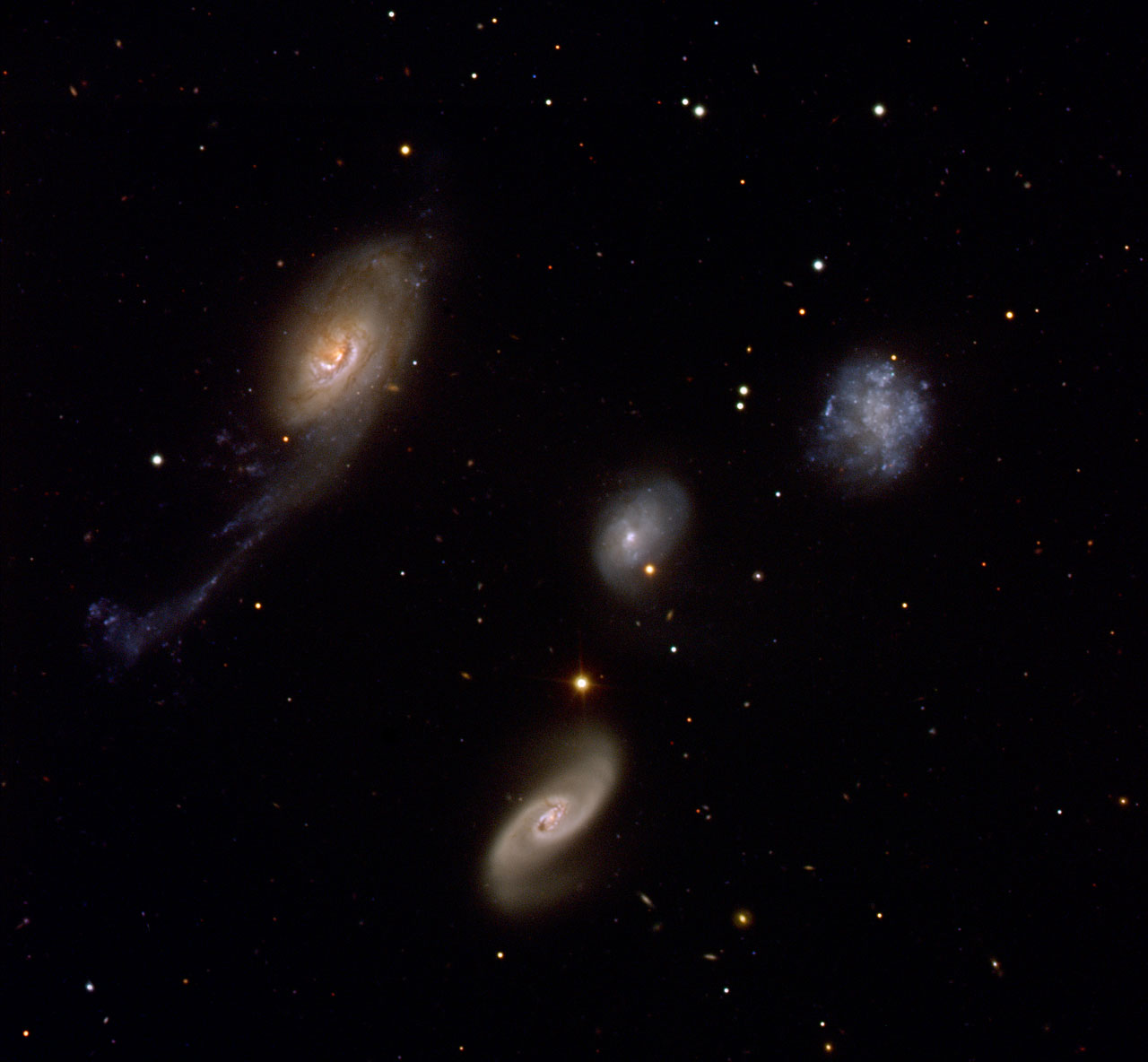
Robert’s Quartet is a compact group of four galaxies approximately 160 million light-years away. The group consists of NGC 87, NGC 88, NGC 89, and NGC 92, which appear close together in the sky. Gravitational interactions have distorted their shapes, particularly NGC 92, which displays an extended tidal tail produced by the movement of stars and gas.
The quartet is an interesting example of how neighboring galaxies can influence one another over millions of years.
Robert’s Quartet is a challenging photographic target and generally requires a large telescope for detailed observation.
NGC 625 — A Nearby Dwarf Galaxy
NGC 625 is a dwarf irregular galaxy approximately 13 million light-years away, near the outskirts of the Sculptor Group. Despite its relatively small size, it contains active regions of star formation and substantial amounts of gas and dust.
Its irregular appearance and young stellar populations make it an interesting subject for studying how smaller galaxies evolve.
NGC 625 is faint, with an apparent magnitude around 11.7, and is best observed through larger amateur telescopes under dark skies.
Meteor Showers Associated With Phoenix
Phoenix is associated with the December Phoenicids, a meteor shower linked to the remains of comet D/1819 W1 (Blanpain). The shower is active around late November and early December, with its radiant located in Phoenix.
The Phoenicids are generally weak, although they have occasionally produced remarkable outbursts, most notably in 1956.
A second, much less active shower, the July Phoenicids, is also associated with this part of the sky.
Neither is normally considered a dependable major annual meteor shower, but the December Phoenicids remain of interest because of their potential for occasional enhanced activity.